

A specialized machine or automated production line often represents an investment of several hundred thousand euros . And the success of the project is determined well before the design phase…
From the drafting of the specifications. A poorly expressed need means a machine that cannot keep up, costly modifications during the project, or a reception that turns into a conflict.
Specifications for a special machine: 5 mistakes to avoid
After more than 30 years designing , machines and lines production for the woodworking, sheet metal and composite industries, our engineers encounter often the same pitfalls. Here are the five mistakes most common, and how to avoid.
What is the purpose of the specifications for a special machine?
The specifications document describes what the future machine must accomplish, under what conditions, and with what level of performance. It serves three purposes:
- Compare manufacturers' offers on a common basis
- Framing the design : this is the reference point for the design office throughout the project.
- Validate the machine upon receipt: we check that it achieves what was requested.
We often talk about functional specifications : they express the need in terms of expected functions and performance, without imposing a technical solution. The NF EN 16271 standard provides the methodological framework.
Mistake #1: describing a solution instead of expressing a need
The trap
"We need a 6-axis robot with two grippers." Many specifications describe the machine we envision rather than the problem to be solved. The manufacturer is then locked into a solution that is not necessarily the best, nor the cheapest.
How to avoid it
Describe what the machine should do, not how it should do it:
- What operation needs to be performed: machining, assembling, deburring, handling, inspecting?
- On which parts, and with what expected result?
- What performance levels are expected: speed, accuracy, availability rate?
You can certainly indicate a technical preference, but present it as a suggestion, not a requirement. An experienced manufacturer will sometimes offer you a simpler, more robust, or more scalable solution.
Error #2: Starting with incomplete production data
The trap
A machine is sized based on your parts and volumes. If this data is approximate, the machine will also be approximate. The most frequent oversights:
- Only the "standard" parts are described, not the larger or more complex ones;
- The average cadence is given, but not the peak cadence;
- The tolerances and expected surface finish are not specified;
- The evolution of the product range in the coming years is not anticipated.
How to avoid it
Compile a comprehensive data file:
- The parts : plans, minimum and maximum dimensions, materials, thicknesses, weights.
- Quality : tolerances, surface finish, unacceptable defects.
- Volumes : hourly rate, production peaks, number of references, series size.
- The outlook : new products, new materials, increased volumes in 3 or 5 years.
And most importantly: provide the manufacturer with actual parts . Testing on your own parts is worth more than any blueprints.
Mistake #3: Forgetting the machine's environment
The trap
A machine never operates in isolation. It is integrated into a workshop, a production flow, and an information system. Too many projects discover during installation that there is insufficient space, inadequate compressed air supply, or that the software cannot communicate with the ERP system.
How to avoid it
Describe the environment in detail:
- The layout : available surface area, ceiling height, access for delivery, type of flooring.
- Energy sources : electrical power, compressed air, suction.
- The flow : where the parts arrive, where they leave, what upstream and downstream stations.
- The information system : design software, ERP or MRP, need for traceability of parts.
- Operators : number of people at the station, skill level, ergonomic constraints.
Mistake #4: Addressing security and compliance at the end of the project
The trap
Safety is often addressed in a single line: "machine compliant with current standards." However, safety directly influences the design: housings, access areas, guards, dust extraction. Adding it as an afterthought is expensive and can sometimes compromise ergonomics.
The regulatory context is also evolving: European regulation (EU) 2023/1230 relating to machinery will replace the Machinery Directive 2006/42/EC from 20 January 2027. Any machine placed on the market from that date must comply with it.
How to avoid it
- Demand CE marking and declaration of conformity, specifying the applicable standard on the scheduled delivery date.
- Describe the specific risks of your activity: dust, noise, heavy parts, cutting.
- Specify internal requirements : lockout/tagout procedures, site safety rules.
- Consider maintenance interventions : they must be able to be carried out safely.
If the new machine is connected to existing equipment, also check the overall compliance. This is precisely the purpose of a compliance process.
Error #5: not defining the reception or post-project phases
The trap
This is the most costly mistake. Without measurable acceptance criteria, delivery becomes a negotiation: the machine works, but does it really deliver what was expected? And once in service, who trains the operators, who provides maintenance, where can spare parts be found?
How to avoid it
Include the following in the specifications:
- Quantified acceptance criteria : rate achieved over a given period, percentage of conforming parts, measured precision.
- Two validation stages : factory acceptance at the manufacturer's premises, then on-site acceptance after installation.
- The documentation includes : instructions, electrical diagrams, programs, and a list of spare parts.
- Training of operators and maintenance technicians.
- After-sales service : response time, maintenance contract, availability of spare parts.
Your specifications checklist
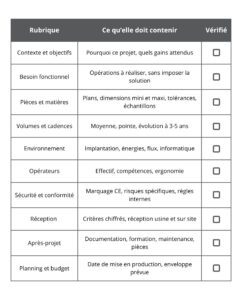
MTI Engineering supports you from the initial expression of your needs
Since 1992, MTI Engineering has been designing, manufacturing, and installing special machines and automated production lines. More than 1,000 machines are in operation at our clients' sites, in the aluminum, wood, and PVC joinery, sheet metal, and composite industries.
Our engineering studies are conducted in-house: mechanical, electrical, automation, and IT. This comprehensive expertise allows us to help you define your needs and then translate them into a reliable solution. After installation, our teams provide training, maintenance, and spare parts.
Are you preparing a special machine or automation project? Describe your needs to us: an MTI engineer will contact you to discuss them, even if your specifications are not yet finalized.
FAQ
Who should write the specifications for a special-purpose machine? The company that buys the machine. Ideally, several departments contribute: production, methods, maintenance, quality, and safety. The manufacturer can then help you refine them.
What is the difference between a functional specification and a technical specification? The functional specification expresses the need and the expected performance. The technical specification, written by the manufacturer, describes the solution chosen to meet those needs.
How long does it take to write a specifications document? It depends on the complexity of the project. Allow several weeks for a production line, especially if multiple departments need to be consulted.
Can you consult a builder before you have a complete set of specifications? Yes, and it's even recommended. A preliminary discussion allows you to identify points that need clarification and avoid going down the wrong path.