
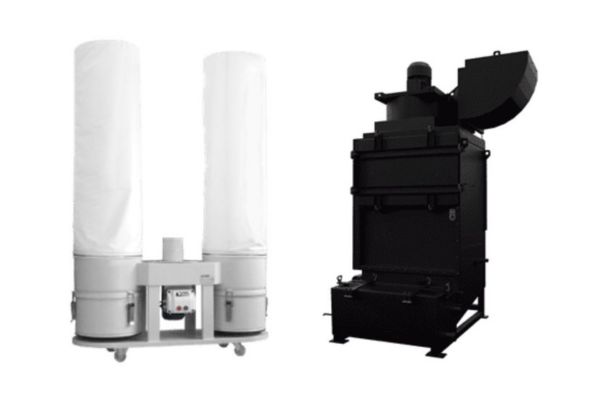
Dry or wet vacuuming: which solution is right for your application?
operations sanding, deburring, or polishing, dust management is a key element. It directly influences the quality of the finish, operator safety , and the reliability of your equipment.
In the field of industrial dust extraction, two main technologies are used:
👉Dry vacuuming
Wetvacuuming
Each one meets specific needs depending on the materials and constraints of the process.
Dry vacuuming: a flexible solution for standard applications
Dry vacuuming is based on a simple principle: dust is captured by an airflow and then retained in filters (cartridges or filter bags).
When to use a dry vacuum cleaner?
This solution is particularly suitable for:
• Steel, stainless steel, copper or brass
• Non-hazardous dust
applications Sanding, deburring or sawing
Its advantages
• ✅Very high filtration efficiency (up to 99.90%)
• ✅Economical and easy-to-implement solution
• ✅Suitable for multi-station installations
• ✅Controlled maintenance thanks to automatic unclogging systems
Points to consider
: • Presence of filters requiring maintenance or replacement
• Potential risk of fire or explosion with certain dusts
• Less suitable for fine metallic or reactive particles
👉 Dry vacuuming is the most widely used solution in standard industrial dust removal.
Wet vacuuming: maximum safety for sensitive materials
Wet vacuuming ( or wet vacuuming) uses water to capture dust. The particles are immediately neutralized and transformed into sludge, preventing their dispersion into the air.
When is wet suction preferable?
This technology is recommended for:
• Aluminum,, titanium and other light metals
dust Flammable or explosive
• Processes that generate sparks
particles Sticky or difficult-to-filter
Its advantages
• ✅Drastic reduction in the risk of fire and explosion
• ✅Effective capture of fine and hazardous dust
• ✅No consumable filters required on some systems
• ✅Solution suitable for sensitive industrial environments
Points to consider:
• Water and sludge management (specific maintenance)
• Higher installation and operating costs
• Constraints related to humidity and corrosion
👉 Wet vacuuming is essential to secure high-risk applications.
How to choose your industrial vacuum system?
The choice between dry or wet vacuuming depends on several key criteria:
- The material being cleaned
• Standard materials → dry vacuuming
• Hazardous or combustible metals (aluminum, titanium) → wet vacuuming - Risk level
• Low risk → dry solution
• Presence of sparks or explosive dust → wet solution - Operating constraints
• Simplicity and cost → dry vacuuming
• Safety priority → wet vacuuming
Conclusion: Which dust removal solution should you choose?
There is no one-size-fits-all solution:
• Dry vacuuming offers performance, flexibility, and cost-effectiveness for common applications.
• Wet vacuuming ensures optimal safety for hazardous materials.
👉 A study tailored to your production allows you to choose the industrial vacuuming solution most efficient, safe and durable